Japan drives on the left
In Japan, vehicles travel on the left side of the road. For someone coming from a right-hand-traffic country, the sense of left and right, the direction of turns, and your position in the lane are all reversed. Especially at first, take care not to drift onto the right side at intersections and corners.
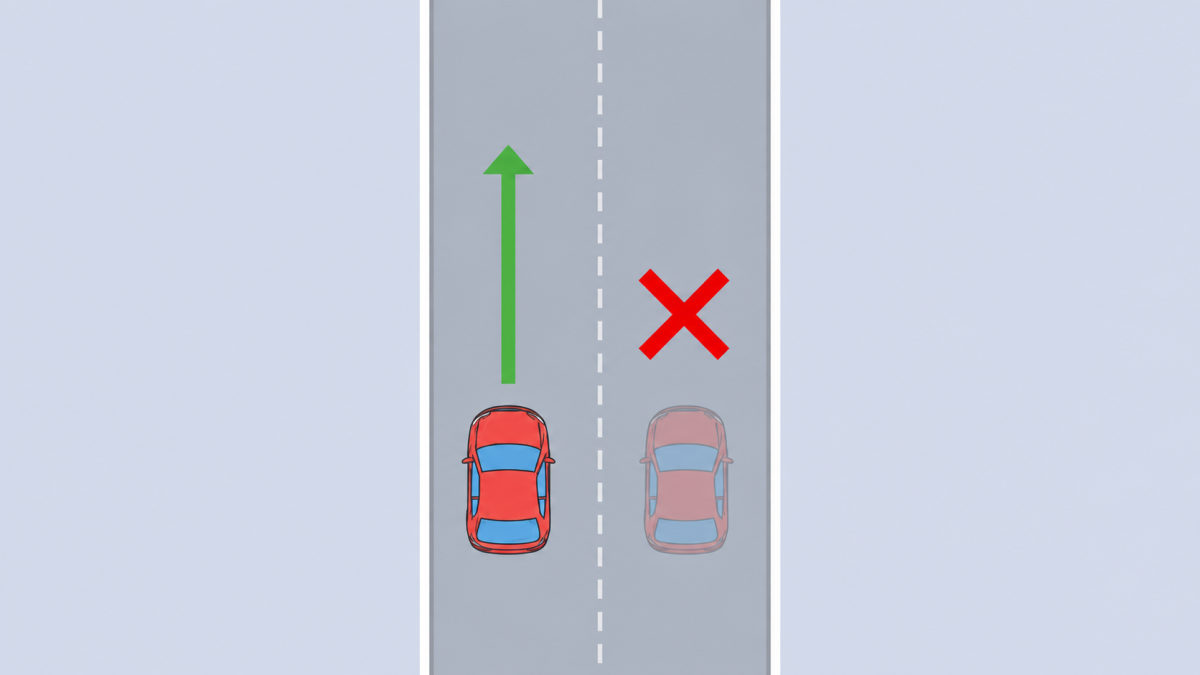
⚠️ This is the single thing drivers from right-hand-traffic countries (mainland China, the USA, continental Europe and others) get wrong most often. It is easy to slip into the right-hand lane just after starting off or after leaving an intersection — stay alert.
Where to drive within the road
- On a road with no marked lanes, keep to the left of the centre line.
- With two lanes in your direction, drive in the left lane and keep the right lane free for overtaking and right turns.
- With three or more lanes, keep the rightmost lane free for overtaking; otherwise slower traffic stays left and faster traffic uses the lanes further right.
- Slower vehicles keep left; overtaking is done on the right.
Legal speeds when no sign is posted
- Ordinary car: 60 km/h (but see the 30 km/h rule below, from 1 September 2026).
- (原付): 30 km/h.
- Small special vehicle (小型特殊): 15 km/h.
These legal speeds apply only where there is no speed-limit sign. A posted speed-limit sign always overrides them.
New from 1 September 2026: 30 km/h on narrow residential streets
From 1 September 2026, on narrow residential streets with no centre line and no lane markings, the statutory maximum for cars drops from 60 km/h to 30 km/h when no sign is posted. This does NOT mean every unsigned road becomes 30 km/h — judge it like this:
- Narrow residential street, no centre line and no lane markings → 30 km/h.
- Ordinary road with a centre line or marked vehicle lanes → still 60 km/h.
- whose directions are separated by a median strip or guard fence → still 60 km/h.
- Motor-vehicle-only roads and similar exceptions → still 60 km/h.
- Any posted sign wins: a 40 km/h sign on a residential street stays 40 — the new rule does not lower it to 30.
Officially announced by the National Police Agency (警察庁). Exams taken after the change can test exactly this distinction — no centre line means 30.
Main differences from right-hand-traffic countries
- The steering wheel is on the right, so your sense of the car's width from the driver's seat is reversed.
- A right turn is the "wide" turn and a left turn is the "tight" turn — the opposite of right-hand-traffic countries.
- Roundabouts are taken clockwise.